
Ask a sales rep where their week went and the answer is rarely “selling”. It goes on researching accounts, updating Salesforce, chasing internal approvals, rewriting the same follow-up email, and waiting for marketing to send the right asset. Marketing has the mirror-image problem: campaigns go out without knowing which accounts sales is actually working.
Harvis Force is SaaSnic’s AI automation initiative aimed at that gap. This article explains what it does, how it works inside Salesforce, and how to try it.
What Harvis Force is (and isn’t)
Harvis Force is a Salesforce-native Lightning application. The parts your team uses live inside Salesforce, built with Lightning Web Components and Apex, so they follow your existing users, profiles, sharing rules and audit trail. Where an outside service is genuinely needed, for example a language model or a data provider, it is reached through secure backend integrations rather than by copying your CRM into another tool.
It is not a separate website your team logs into. Today it is available to selected businesses for pilots and demos; we intend to distribute it as a managed package through Salesforce AppExchange later.
Where it stands today
| Capability | Status |
|---|---|
| Prospect and account research | Ready for pilots and demos |
| Lead qualification | Ready for pilots and demos |
| Relationship intelligence on Salesforce data | Ready for pilots and demos |
| Salesforce workflow actions (tasks, notes, updates) | Ready for pilots and demos |
| Human-approved outreach drafts | Ready for pilots and demos |
| Coordinated digital marketing | Ready for pilots and demos |
| AppExchange managed package | Planned |
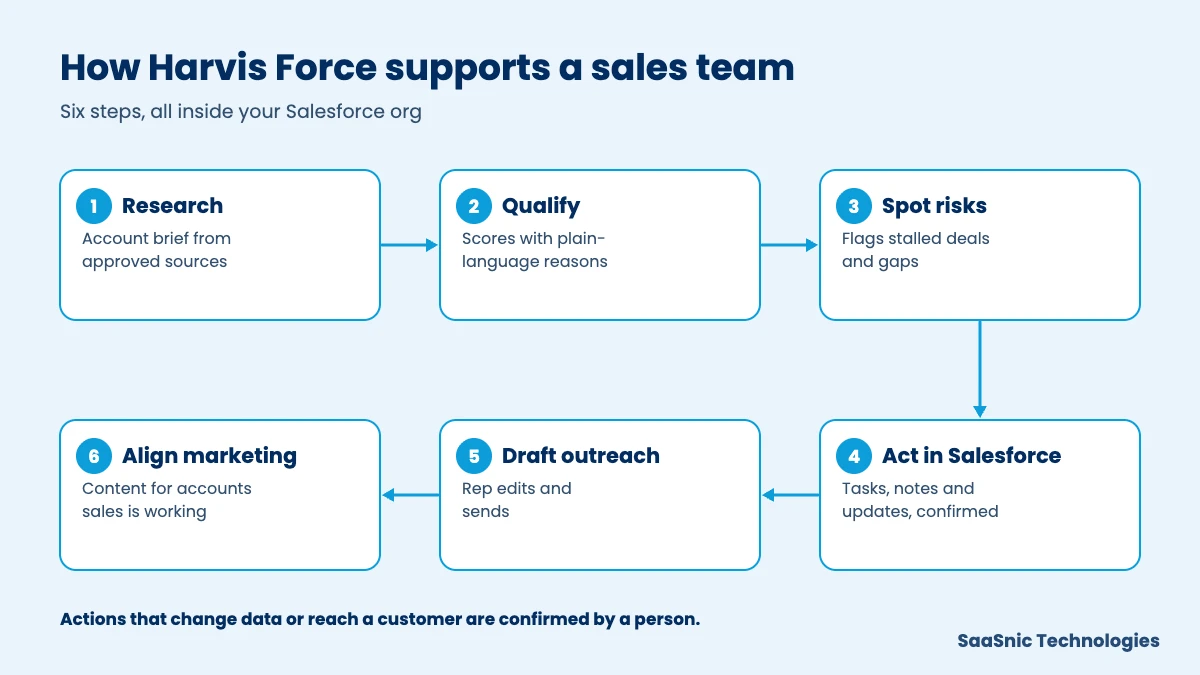
1. Prospect research without the browser tabs
The problem: before a first call, a good rep checks the company’s website, recent news, team size, technology and any history in Salesforce. Done properly it takes real time for every account, so under pressure it often isn’t done at all.
The design: Harvis Force assembles a short account brief on the Salesforce record from approved sources: public company information, your own CRM history, and data sources you are licensed to use. It uses sources only within their terms and does not scrape sites such as LinkedIn that do not permit it. The rep sees where each fact came from and can correct it.
Example (illustrative): an inside sales rep opens a new inbound lead from a 200-person logistics firm. Instead of starting from a blank page, they see a summary of what the company does, two previous conversations logged three years ago by a colleague, and a note that the contact’s role suggests they are an evaluator rather than a buyer.
2. Qualification you can explain
The problem: many lead scores are a black box. Reps ignore them because they can’t see why one lead is “hot” and another isn’t.
The design: qualification rules are set by your sales leadership, written in plain language, and stored in Salesforce. Harvis Force applies them and shows its reasoning (“fits target industry; budget not confirmed; no decision-maker identified”). A manager can change the rules without a developer, and a person can override any score.
3. Relationship intelligence on the data you already have
The problem: the warning signs of a slipping deal are usually already in Salesforce: no activity for three weeks, a champion who changed jobs, a close date pushed twice. Nobody has time to look across every opportunity.
The design: Harvis Force reviews open opportunities and contacts and flags the few that need attention, with a suggested next step. It reads only what the user is allowed to see under your existing Salesforce sharing rules.
Example (illustrative): a sales manager starts Monday with a list of five opportunities, not fifty: two with no logged activity since a pricing call, one where the main contact’s email is bouncing, and two whose close dates have moved more than once.
4. Salesforce workflows that close the loop
Insight is only useful if something happens next. Harvis Force turns suggestions into normal Salesforce work: a task for the rep, a note on the account, a field update, or a request routed to the right approver. Actions that change data or affect a customer are proposed first and confirmed by a person, so nothing is changed silently.
5. Outreach a human approves
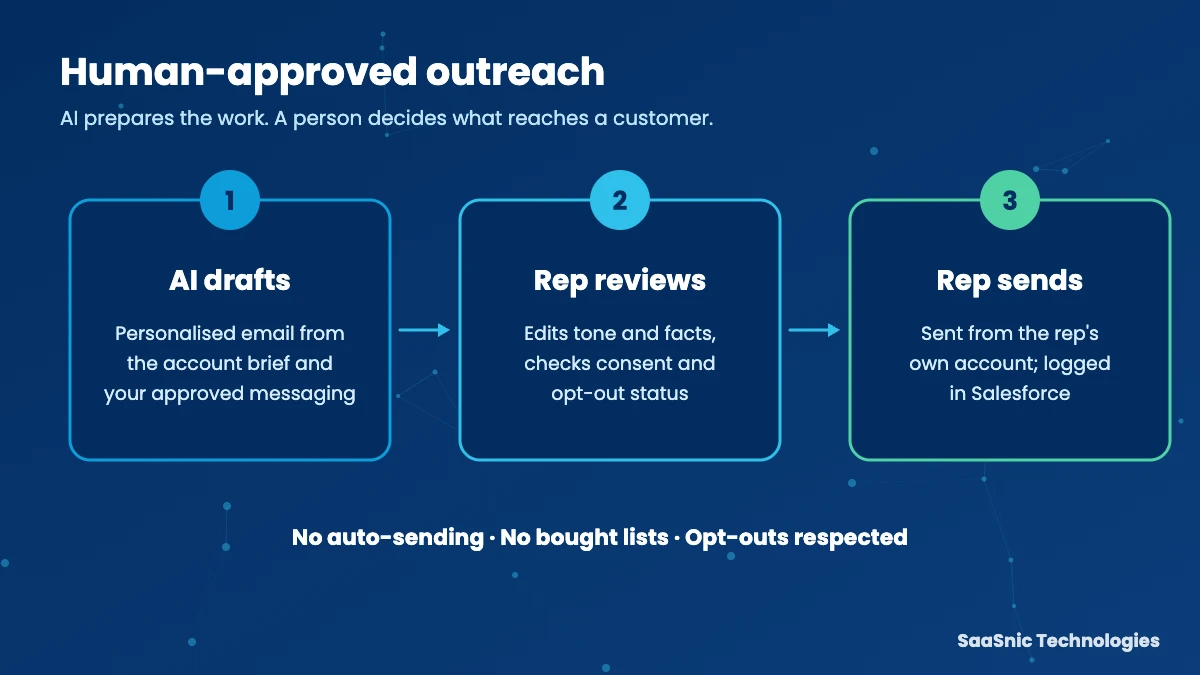
The problem: AI can write a thousand emails an hour. That is exactly the risk. Unreviewed, mass-generated outreach damages sender reputation, brand trust and, in many countries, breaks the law.
The design: Harvis Force drafts a personalised first email or follow-up using the account brief and your approved messaging, for the rep to edit and send. It does not send messages on its own, buy contact lists, or contact people who have opted out, and it respects opt-outs and consent preferences recorded in Salesforce.
6. Coordinated digital marketing
Harvis Force connects the same account picture to marketing. Marketing sees which accounts sales is actively working and can tailor content and campaign drafts to them, while sales sees which accounts are engaging with marketing. Every piece of content is reviewed and approved by your team before it goes anywhere.
The principles behind the design
- People decide. AI prepares, suggests and drafts; a person approves anything that reaches a customer or changes important data.
- Salesforce stays the system of record. Your data, permissions and audit history remain in your org.
- Explainable, not magic. Every score and suggestion shows its reasons and sources.
- Permission-based data. Only sources you are entitled to use, used within their terms.
Who it is for
Small and mid-sized sales teams that already run on Salesforce, have more leads and accounts than time, and want AI help without losing control of their data or their brand. If that sounds like you, we would like to hear how your team works today; it directly shapes what we build next.
How this fits with Salesforce’s own AI
Salesforce is investing heavily in Agentforce and its own sales agents (see our round-up of Salesforce AI trends for 2027). Harvis Force is not a replacement for those. It sits alongside them inside your org, focused on the specific research, qualification and follow-up workflows that small and mid-sized teams commonly struggle with. Many teams may use both, and we can help you decide.
Discuss your AI automation requirements
Harvis Force is available to selected businesses for pilots and demos. Whether or not it is the right fit, SaaSnic can help you work out where AI will actually save your sales and marketing team time, and where it won’t. Discuss your AI automation requirements with our team.
Harvis Force is currently offered for pilots and demos. Features and names may change before general release. Salesforce, AppExchange and Agentforce are trademarks of Salesforce, Inc.; Harvis Force is not a Salesforce product.