
Two years ago, “AI in Salesforce” mostly meant a chatbot or an email draft button. After Dreamforce 2026, it means something very different: AI agents that work across your CRM, your Slack and even your AI assistant of choice, and that can run a task for weeks instead of seconds.
Salesforce announced 21 new products and features at Dreamforce 2026. You don’t need all of them. Below are the eight trends that matter most for sales, service and operations teams planning their 2027 roadmap, what each one actually is, and where it stands today.
1. Salesforce comes to wherever you work (AIforce)
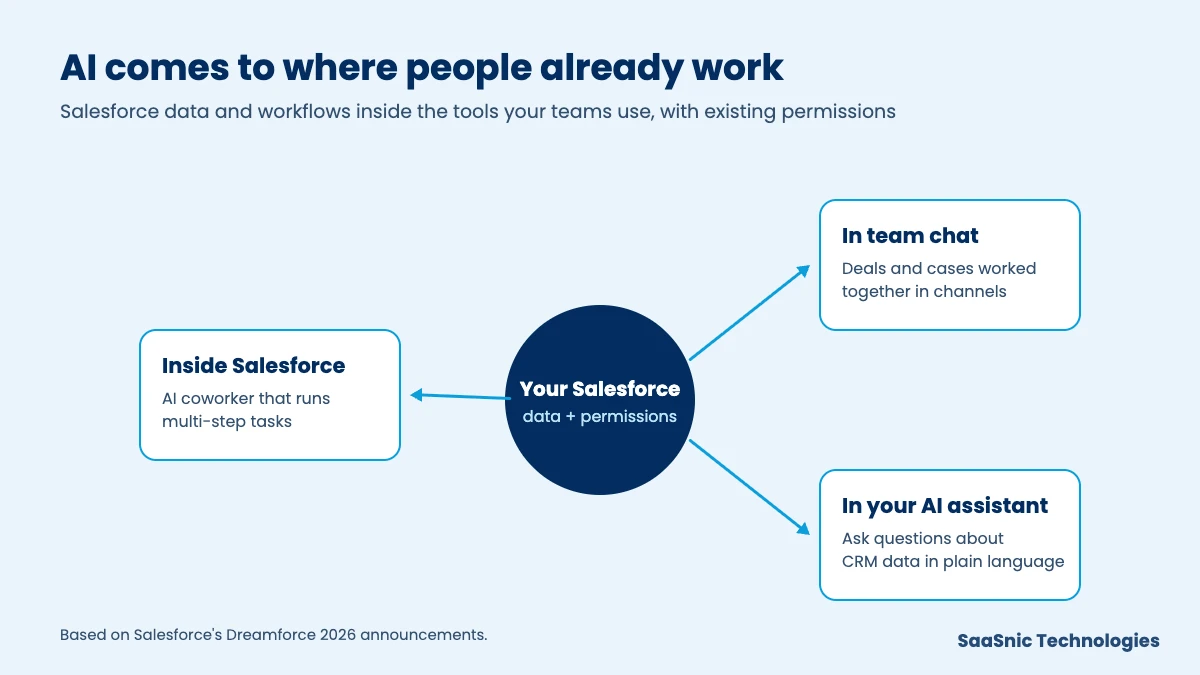
The headline of Dreamforce 2026 was AIforce: Salesforce data, apps and workflows delivered inside the tools people already use, while keeping your existing user permissions. It comes in three forms:
- Agentforce Coworker: an AI teammate built into Salesforce itself. You ask questions in plain language and it can carry out multi-step tasks across your CRM and connected sources. Available now.
- Slackforce: Salesforce context inside Slack, so deals and cases can be worked in channels with your team and AI together. Announced as generally available from October 2026.
- Claudeforce: Salesforce inside Anthropic’s Claude, built with Anthropic. Currently in beta.
What it means for you: your users may spend less time clicking through Salesforce screens and more time asking for what they need. That makes clean permissions and a well-structured data model more important than ever, because the AI can only see and do what your security setup allows.
2. Ready-made agents for specific jobs
Instead of building every agent from scratch, Salesforce now offers pre-built “job-ready” agents with a defined role:
- Piper handles inbound sales and lead qualification.
- Fin handles customer service conversations.
- Hunter works outbound pipeline, from research to outreach, alongside your sellers. General availability was announced for November 2026.
- Marshall focuses on back-office work such as supply chain and operations.
What it means for you: faster time to value. The real work shifts from “building an agent” to configuring it around your process, your data and your rules for when a human must step in.
3. Agents that work for weeks, not seconds
Most AI today answers a question and stops. Salesforce’s new long-horizon agents pursue a goal over days, weeks or months. They keep a plan, remember where they are, recover from problems, and pause at approval checkpoints so a person signs off before key steps. They were announced in pilot, with general availability planned for November 2026.
What it means for you: think of processes that today live in spreadsheets and reminders, such as renewals, onboarding a new customer or chasing a long sales cycle. These are the first candidates for a long-running agent, with your team approving the important moves.
4. AI models built specifically for CRM
Salesforce introduced Koa, its first reasoning model designed for CRM work in Agentforce. It is built on NVIDIA Nemotron and trained on synthetic data, so customer data is not used to train it. Koa is in pilot, with general availability expected in Winter 2026.
What it means for you: businesses will increasingly mix models: a general-purpose model for open-ended questions and a specialised one for structured CRM tasks. Choosing the right model per task will become part of normal Salesforce administration.
5. Agents that build and improve other agents
Three announcements point the same way:
- Agent Optimizer helps build and refine agents and spots recurring failure patterns in production.
- AI Skills let you teach a governed, reusable instruction once and use it in any agent.
- Multi-agent orchestration adds a single “front door” agent that routes work to specialist agents, including third-party agents on AWS, Azure and Google.
What it means for you: the winning setup is not one giant agent but a small team of focused agents that share approved skills. Start by writing down the tasks you repeat most and the rules that govern them; those become your first skills.
6. Testing and monitoring AI becomes standard practice
As agents move into production, Salesforce added the tools to keep them honest: Agent Health Monitoring with built-in metrics and alerts, Custom Scorers to grade real agent sessions against your own criteria, A/B Experimentation to compare agent versions, and full multi-turn conversation testing across text and voice.
What it means for you: treat an AI agent like a new employee on probation. Define what “good” looks like before launch, measure it every week, and keep improving. Teams that skip this step are the ones that lose trust in AI after a few bad answers.
7. Voice goes mainstream
Field Voice brings a hands-free voice agent to the Salesforce mobile app for account summaries and dictated notes, and Agentforce Voice now supports Spanish, Italian, German, Portuguese, Japanese and Canadian French. Voice access for internal employee agents is in pilot.
What it means for you: field sales and service teams, who rarely sit at a desk, can finally update Salesforce as they work. That means better data with less nagging.
8. Your data is still the foundation
Every trend above depends on one thing: trusted, connected data. Salesforce’s customer data platform, formerly Salesforce Genie and then Data Cloud, was renamed Data 360 in October 2025 and sits underneath Agentforce. (We explain the name changes in Salesforce Genie Is Now Data 360.)
What it means for you: if your Salesforce org has duplicate records, missing fields or disconnected systems, AI will repeat those problems faster. A data clean-up and integration review is still the best first AI project.
How to get ready for 2027: a simple checklist
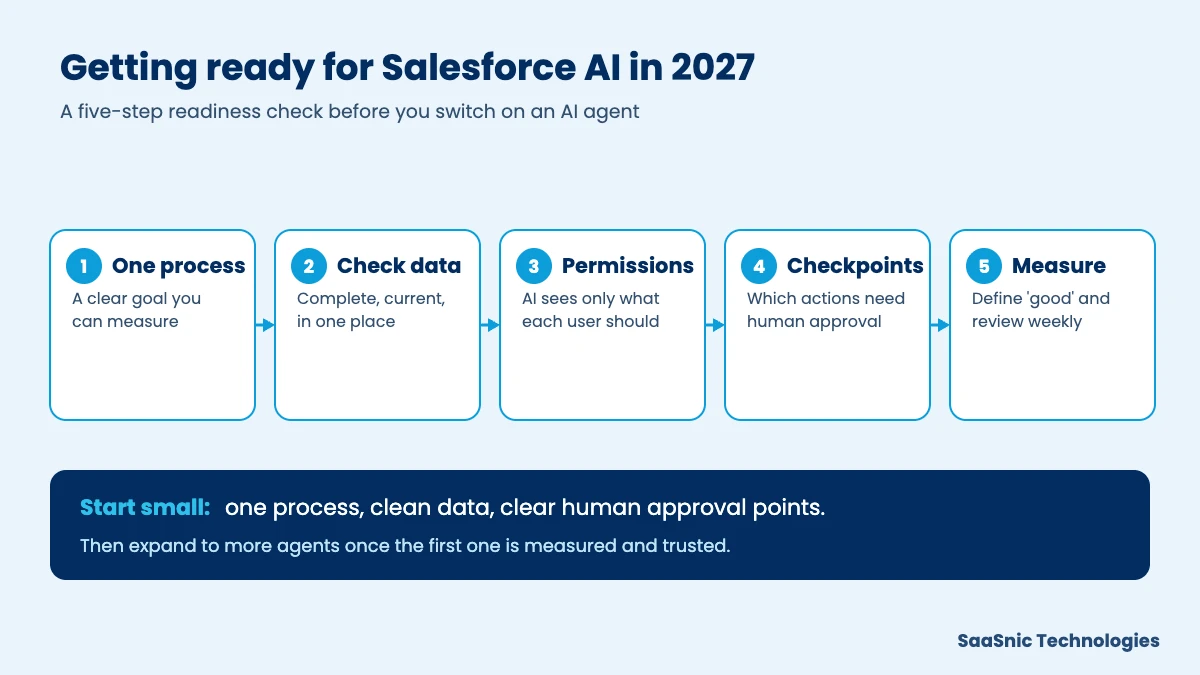
- Pick one process with a clear goal and measurable outcome, such as lead follow-up or case triage.
- Check your data for that process: is it complete, current and in one place?
- Review permissions so AI tools only see what each user should see.
- Decide the human checkpoints: which actions an agent may take alone, and which need approval.
- Set success measures before launch and review them weekly.
Discuss your AI automation requirements
SaaSnic Technologies has been helping businesses get more from Salesforce for 15 years. We help teams choose the right AI use case, prepare their data, and roll out Agentforce and Salesforce AI with sensible guardrails, as part of a wider Salesforce implementation or as a focused project.
Not sure which of these trends matter for your Salesforce org? Discuss your AI automation requirements with our team.
Product names and availability are as announced by Salesforce at Dreamforce 2026 and can change. Source: Salesforce, “21 Things We Announced at Dreamforce 2026”.