
Recruiters tell a familiar story. Finding the right open roles takes hours. Shortlisting can mean reading a pile of CVs for every role. Booking first interviews turns into a week of email back-and-forth. Interview notes end up scattered across notebooks and inboxes. Meanwhile good candidates accept other offers.
AI could remove much of that admin. It could also make hiring less fair and less private if it is built carelessly. This article describes Harvis Force Recruitment, SaaSnic’s AI recruitment app, and the rules it follows. It is now available to selected recruitment teams for pilots and demos.
The principles come first
- Humans make hiring decisions. The tool organises information; recruiters and hiring managers decide who moves forward.
- Consent before AI. Candidates are told clearly when AI is involved and can choose a human alternative.
- Permission-based data. Only roles and candidate information that people have chosen to share, or that come from sources licensed for this use.
- Fairness is tested, not assumed. No feature is treated as “bias-free”; outcomes should be checked regularly.
- Collect less, keep less. Only the data needed for the role, kept only as long as needed.
How it works
Like Harvis Force for sales, it is built around Salesforce: recruiters work in a Salesforce-native Lightning application, with candidate and role records held in the organisation’s own Salesforce org. Here is each stage.
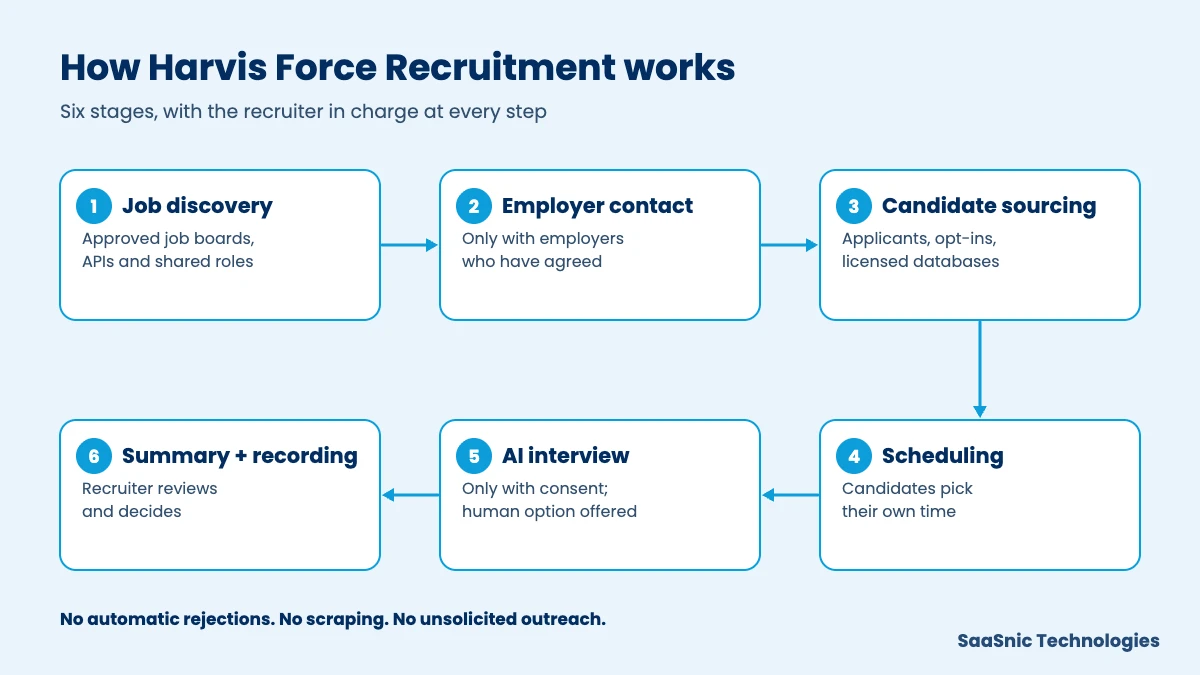
1. Job discovery
For a recruitment agency, the first job is knowing which employers are hiring for roles it can fill. It gathers openings only from job boards and APIs whose terms allow it, and from roles employers share directly. It does not scrape sites that prohibit it.
2. Authorised employer engagement
The app helps recruiters prepare a relevant introduction to an employer, but a recruiter reviews and sends it. Ongoing work happens only with employers who have agreed to work with the agency, and that agreement is recorded. No automated, unsolicited outreach.
3. Candidate sourcing
Candidates come from people who applied, people who opted in to hear about roles, and databases the agency is licensed to use for this purpose. The app helps match them to roles on job-related criteria only. It does not submit applications on a candidate’s behalf, and it does not build profiles by collecting data from across the web.
4. Interview scheduling
Candidates receive a link and choose a time that suits them from the interviewer’s real availability. Reschedules and reminders are handled automatically. This is often the biggest time-saver.
Example (illustrative): an agency recruiter shortlists eight candidates on Tuesday morning. By Tuesday afternoon, six have booked first-round slots themselves, without a single email thread.
5. Consent-based AI interviews
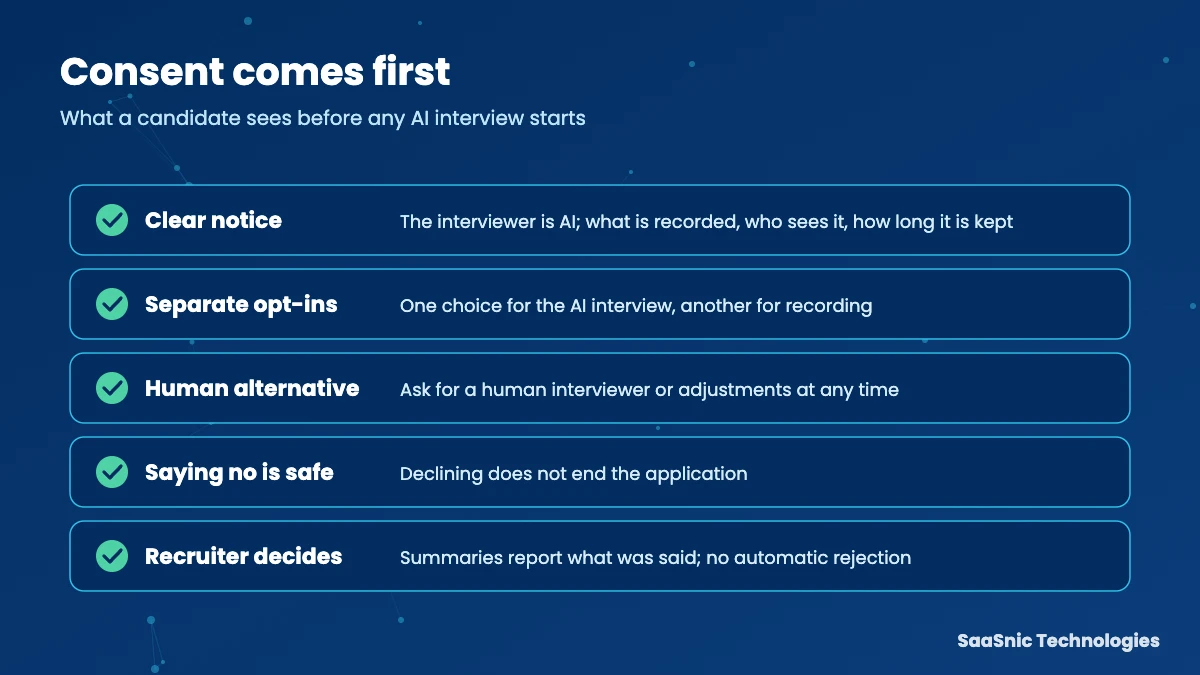
Some employers want a short, structured first-round conversation that every candidate can take at a time that suits them. An AI interviewer asks the same job-related questions to every candidate, under strict conditions:
- Before anything starts, the candidate is told in plain language that the interviewer is AI, what is recorded, who will see it and how long it is kept.
- The candidate actively agrees to the AI interview and, separately, to recording. Saying no does not end their application.
- A candidate can ask for a human interviewer instead, or for adjustments if they have a disability.
- Questions are approved by the employer and the recruiter in advance and relate only to the job.
6. Recruiter-facing summaries and recordings
After an interview, the recruiter receives a neutral summary of the candidate’s answers and, where the candidate agreed, the recording. The summary reports what was said; it does not score personality, emotion, facial expressions or anything linked to protected characteristics. The app does not reject candidates automatically. A recruiter reviews every candidate and makes the decision.
Recordings are visible only to people involved in that hiring process, kept for a defined period, and deleted on request where the law allows.
Guarding against discrimination
AI can repeat the biases in the data it learns from. A responsible recruitment tool needs, at minimum: job-related criteria only; protected characteristics excluded from matching and summaries; regular testing of outcomes across groups; and a clear way for candidates to question a decision and reach a person. We treat these as requirements, and we recommend that each organisation tests outcomes for its own roles and candidates.
The legal landscape (context, not legal advice)
AI in hiring is regulated in a growing number of places. Examples an organisation would need to consider include data-protection laws such as the EU and UK GDPR, the EU AI Act, which lists AI used for recruitment or selection as high-risk (European Commission AI Act Service Desk), and local rules such as New York City’s Local Law 144, which requires bias audits and candidate notices for automated employment decision tools (NYC DCWP FAQ). Requirements differ by country, state and use case.
This article is not legal advice, and we do not claim that the app meets any specific law. Organisations using AI in hiring should check the rules that apply to them and take their own legal advice.
Where this stands
Harvis Force Recruitment is available to selected recruitment teams for pilots and demos; it is not yet generally released. We would rather discuss trust, consent and fairness openly with recruiters and employers from the start.
Harvis Force also supports sales and marketing teams: see Harvis Force for sales and digital marketing. For the wider picture, read our Salesforce AI trends for 2027, and see our privacy policy for how SaaSnic handles personal data.
Discuss your AI automation requirements
Run a recruitment team or agency and spend too much time on scheduling, notes and admin? Pilots and demos are available to selected teams, and we would like to understand your process. Discuss your AI automation requirements with SaaSnic.
Harvis Force Recruitment is currently offered for pilots and demos; features may change before general release. Nothing in this article is legal advice or a statement that any law has been complied with. Salesforce is a trademark of Salesforce, Inc.; Harvis Force is not a Salesforce product.